Conception

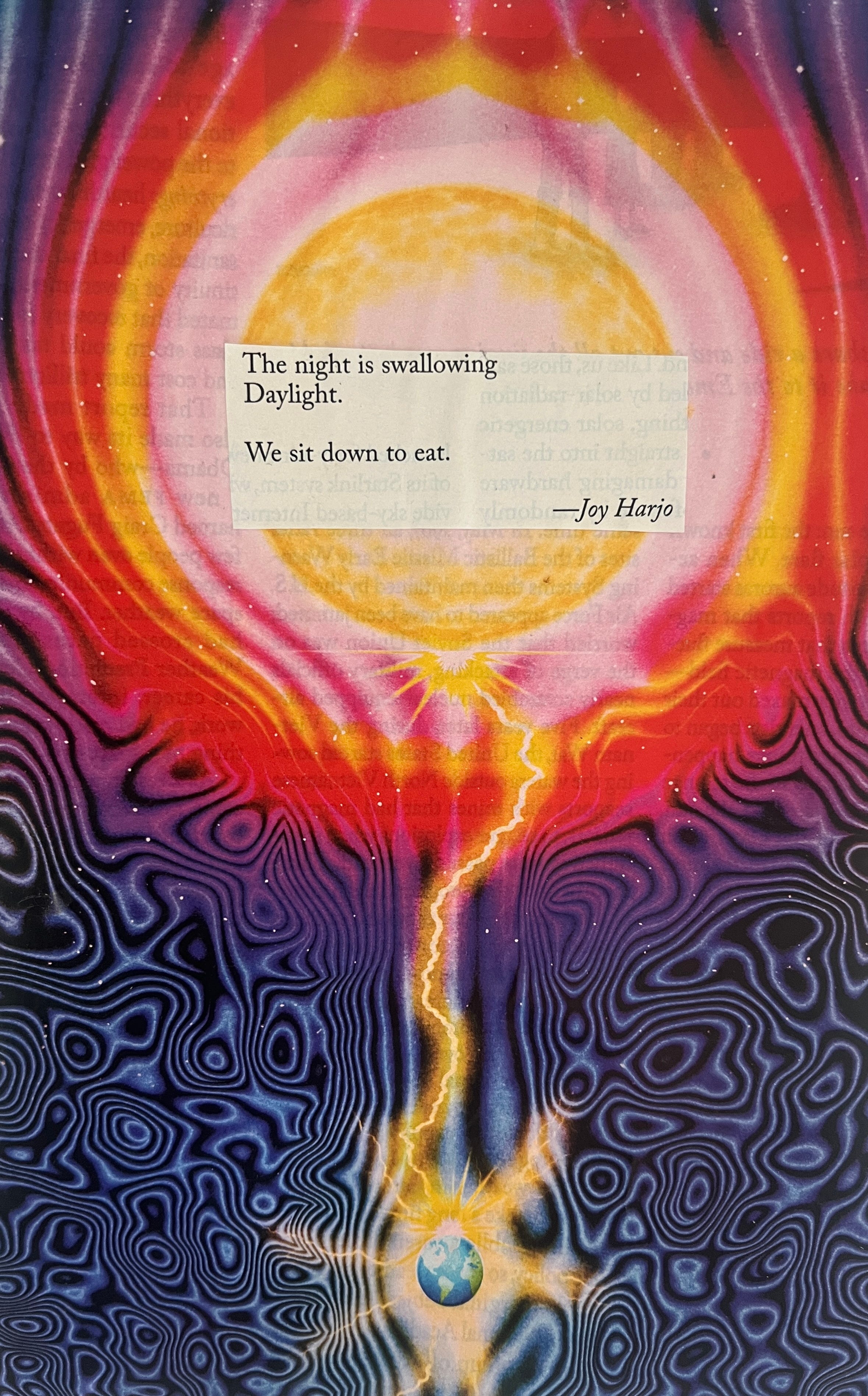
Birth is a wet and violent process.
Death can come so quietly you barely perceive the shift,
So I have to believe that when the city of Port Royal sank,1 and 25 tons of silver was lost to the sea a second time,2
It wasn’t a natural disaster. It was the Earth offering us another chance at life, splitting in two and swallowing us whole so that we might recognize the fault lines we’d been etching across our backs for centuries.
The cold, unforgiving taste of rusted silver on our tongues ought to have been a reminder of what the enslaved divers who first recovered the doubloons from The Concepción already knew:
Freedom is the only thing worth purchasing.
They knew what it is to be wet with desire.
Knew the ocean only offers redemption once (if you’re lucky).
Knew you have to go deep to access it.
They knew how to alchemize the darkness of the tomb into the lifegiving potential of the womb.3
Knew that “What constitutes our nation and us its citizens is not legal statutes or documents and the identities and relationships they constituted in us and for us… [it] is our capacity to imagine.”4
When the enslaved divers Sir William Phips had hired first presented him with the silver they had recovered from the ocean floor, all he could see was the makings of a sloop – a mechanism to acquire more wealth, a way to cut through the water without ever letting it touch you.
But they saw the faces of their kin. Free.5
On June 7th 1692, when the earthquake tore Port Royal in two, the Earth must have been grieving the stillbirth of a dream. I imagine the rumbling that eventually swallowed Port Royal grew out of the empty pit in the Earth’s stomach. The kicking stopped the moment she realized the futility of her attempts to transfer the feeling of a concept as expansive as liberation or kin or community to a man who had never even gone swimming. Never lost himself in the deep and emerged breathless and panting, the Earth’s gravitational pull and release reminding him of the orgasmic power of the inexplicable – and therefore uncontrollable – a wet pussy throbbing, desire without attachment to an outcome, with no blatant visual cue signaling “I have achieved something,” just the incomparable pleasure of emerging from the sea dripping wet, the water droplets already evaporating from the sun on your cheek.
Isn’t it marvelous the way our skin absorbs everything?
Dissolving artificial boundaries between prehistoric algae and a plastic bikini, fluid and solid, before and after, you and me.
When my grandmother “Soni” died, her dog Misty licked the salt from every inch of her body, the ocean surfacing for a moment, as if to say “I was always inside you, but never yours to keep.”
At her memorial service, on Zoom, I read a quote from James Baldwin and cried in the presence of strangers from every corner of the globe and moment in her life story and the salt water of her body came back to me, as if transmuted through the thin blue screen.
This was shortly before I sat on another Zoom call with my students as we took a “break” from our unit on Reconstruction to bear witness to white backlash reincarnated in the rioters at the capitol on January 6th, 2021.
So the cyclical nature of all things is not new. I notice it everywhere, this repeated death we are experiencing, a karmic response to Sir William Phips’ refusal of the sea.
When will the tomb become the womb?
We are stuck in the green room. A nation afraid of release.
Not yet born, lashing out at those who exist in this liminal space alongside us, but illustrate that we already have all of the tools we need to be free.
“Perhaps the whole root of our trouble, the human trouble, is that we will sacrifice all the beauty of our lives, will imprison ourselves in totems, taboos, crosses, blood sacrifices, steeples, mosques, races, armies, flags, nations, in order to deny the fact of death, which is the only fact we have. It seems to me that one ought to rejoice in the fact of death – ought to decide indeed to earn one’s death by confronting with passion the conundrum of life. One is responsible to life: It is the small beacon in the terrifying darkness from which we come and to which we will return.”6
I have always been afraid of my capacious desire, my insatiable appetite for questions, the way my mind darts from one idea to another – as if the connections were as obvious to everyone else as my brain makes them seem to me. But your body comes alive when I run my hands along your spine. When you shiver,
I feel certain my curiosity is the only thing that will let me grasp the concept of a life where we don’t need Spanish doubloons to be free, where my identity is so slippery and ephemeral it exists only in the moment of dissolution when your body becomes mine, and my body becomes the Earth, trembling.
I feel utterly shameless lying naked in your arms, letting the wet of your saliva coat the back of my throat, the salt of your skin against my cheek.
Maybe we can re-parent a nation.
Gratitude to water and pussy and the enslaved divers and their descendants who know what it is to be wet.
If we’re lucky maybe the ocean will offer us redemption a third time. May we be ready to accept it, falling backwards into each other, the saltwater within us rising to the surface so that we may greet one another with fresh eyes in our collective grief.
Let us be amniotic fluid,7 cushioning against the impending quake. Let our bodies writhe in the ecstasy of collapse.
If we are saltwater, we can never become unmoored.
This poem is dedicated to my grandmother Sonya “Soni” Orleans Rose whose work explored the creation and intersection of gender, class, race, and empire long before I was ever conceived.
This poem was inspired by my work on the Reimagining New England Histories Curriculum Committee through the Center for the Study of Slavery and Justice at Brown University. I was particularly inspired by Dr. Kevin Dawson and Dr. Akeia De Barros Gomes’ presentations at the Teach In: Black and Indigenous Histories on March 8, 2025.
You can learn more about and access the Reimagining New England Histories curriculum for free here.
This poem took shape on March 27, 2025 at Dr. Melane Ferdinand-King’s inaugural Wayfinders Writing Salon, a three-hour writing workshop honoring the lives and work of Nikki Giovanni, Judith Jamison, and Bernice Johnson Reagon at Mixed Magic Theatre in Pawtucket, RI.
You can learn more about and support Mixed Magic Theatre’s work to amplify Black stories and cultivate Black storytellers here.
On June 7, 1692, an earthquake caused much of Port Royal, Jamaica to slide beneath the ocean. Port Royal had been an important center for salvaging wealth from the colonial ships that often wrecked during hurricane season. White pirates and salvagers assembled teams of “Diving Negroes” to work the wrecks, amassing their treasure in waterfront homes, many of which were destroyed during the earthquake. See Page 63 of Dr. Kevin Dawson’s History Below the Waterline: Enslaved Salvage Divers Harvesting Seaports’ Hinter-Seas in the Early Modern Atlantic for more information.
On October 31, 1641, The Spanish galleon Nuestra Señora de la Concepción sank in sixty feet of water on Ambrosia Banks (now Silver Bank) off Hispaniola. In 1686, William Phipps, who would later be appointed governor of the British colony Massachusetts, colluded with Bermudian captains William Davis and Abraham Adderley, to recover over twenty-five tons of gold and silver worth some £300,000 sterling from it. Davis arrived at the wreck in a Bermudian “Sloope” that he “fitted” with “ten gunns” in Barbados. Their diver contingents were comprised of captives from Bermuda, Jamaica, and Barbados including John Pasqua, Francis Anderson, and Jonas Abimeleck, who were enslaved divers from Port Royal, Jamaica, and four Mosquito Indians who held fled Nicaragua; one named Amataba and another named Sancho. See Pages 54-55 of Dr. Kevin Dawson’s History Below the Waterline: Enslaved Salvage Divers Harvesting Seaports’ Hinter-Seas in the Early Modern Atlantic for more information.
Valarie Kaur, who founded the Revolutionary Love Project, often asks “What if this is not the darkness of the tomb, but the darkness of the womb?”
See Page 3 of the February 2025 Issue of Motif magazine where Guest Editor James Haile paraphrases self-emancipated abolitionist Frederick Douglass.
Many enslaved divers were able to purchase their freedom and the freedom of their families with their earnings.
This is a direct quote from James Baldwin, The Fire Next Time, pg 91-92. Baldwin goes on to say that “white Americans do not believe in death, and this is why the darkness of my skin so intimidates them.”
Professor Akeia De Barros Gomes noted that the salinity of amniotic fluid and seawater is almost identical and that the earliest lifeforms on Earth were born in, and emerged out of, the ocean in her presentation on March 8, 2025 during the Teach In: Black and Indigenous Histories at the John D. Rockefeller Library at Brown University as part of the Center for Slavery and Justice’s efforts to launch the Reimagining New England Histories Curriculum.